Culture
Balinese music and dance: gamelan, legong, kecak and barong
In the evening, in Ubud, a bronze orchestra sets up under a temple gate and a dancer enters, eyes wide open. Balinese dance is easy to see. Knowing what you are watching, and what is not meant to be seen, changes everything.
- Updated on
- 6 min read
- By Kylian Dev
Contents
Key points
- Ubud is the place for evening shows: several stages every evening, at the palace and in the temples nearby.
- A dance evening in Ubud: about €5 to €7.50; the Uluwatu kecak: €7.50 to €10, temple entry extra. Observed ranges.
- Shows generally last one hour to one and a half hours, with no dress code outside temples.
- The sacred dances of ceremonies are not sold: a paid show takes up the secular repertoire, performed by real village troupes.
In Bali, music and dance were not originally stage arts: they accompany ceremonies, welcome the gods and entertain the ancestors. Every village, every neighborhood has its orchestra, the sekaa gong, which rehearses in the evening in the community pavilion. The shows offered to visitors grew out of this practice.
This guide presents the forms you see most and how to see them. The religious context is in Balinese temples and culture, the ceremonies where people dance for the gods in Bali ceremonies and cremations.
The gamelan, the Balinese orchestra
The gamelan is an orchestra of metallophones, gongs, cymbals and drums, played by some twenty musicians or more. The instruments come in pairs, tuned very slightly apart, which gives the sound its characteristic shimmer. The parts interlock so quickly that no musician plays the whole melody alone.
The drum, the kendang, leads the ensemble: it gives the starts and the sudden stops that the dancers follow. The large gong marks the cycles.
- Gong kebyar: the most widespread style, born at the beginning of the 20th century in the north of the island, brilliant and fast.
- Semar pegulingan: softer, once associated with the palaces, often played for the legong.
- Gender wayang: four metallophones that accompany shadow puppet theater and some rites.
- Jegog: a gamelan of giant bamboos, specific to the Jembrana region, in the west.
Hearing a village rehearsal in the evening is often as memorable as a show. If you are staying in a guesthouse in Sidemen or around Ubud, ask where the banjar orchestra rehearses: you can listen from a distance, without going in.
Legong, kecak, barong: the dances you see most
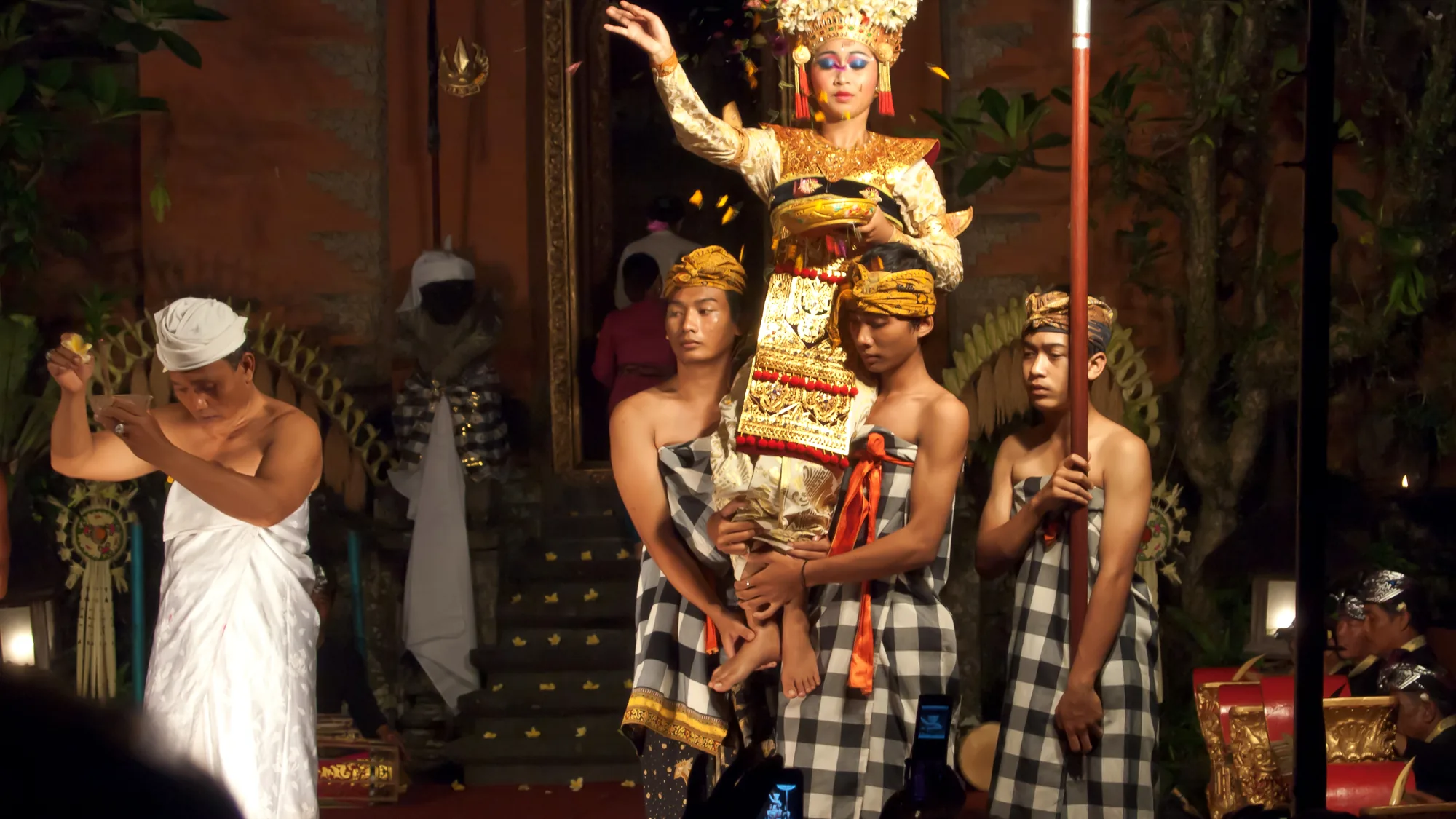
Three dances dominate the programs. The legong, danced by young girls, is the most refined: finger gestures, gaze, golden costume. The kecak replaces the orchestra with a male choir that chants and tells the Ramayana. The barong stages the fight between a protective creature and the witch Rangda.
Legong
A court dance, learned from childhood. The dancers tell a story of a prince and a princess through their eyes, fingers and fan. Most often performed in Ubud.
Kecak
A circle of bare-chested men chants “cak” in interlocking rhythms. It took its current form in the 1930s, from a trance chant, the sanghyang. Performed at Uluwatu temple at sunset, and in Ubud.
Barong and Rangda
The barong, brought to life by two dancers, confronts Rangda, a figure of disorder. Neither wins: balance is restored. Some shows include dancers armed with kris, daggers turned against themselves in a simulated trance.
Bali’s dances have been inscribed since 2015 on UNESCO’s Intangible Cultural Heritage list, under the title “Three genres of traditional dance in Bali”.
Sacred dance or tourist show: telling the difference
The Balinese distinguish three genres: sacred dances, wali, reserved for the inner courtyard of the temple during ceremonies; semi-sacred dances, bebali, performed in the middle courtyard; and entertainment dances, balih-balihan, performed everywhere. A paid show takes up this third genre, or short versions of the second.
| Genre | Where | The visitor |
|---|---|---|
| Wali, sacred | Inner courtyard of the temple, during a ceremony | Never sold; you only attend if invited |
| Bebali, semi-sacred | Middle courtyard, during festivals | Can watch properly dressed, at a distance, during an odalan |
| Balih-balihan, entertainment | Pavilions, stages, outer courtyard | Evening shows, festivals, tickets |
A show for visitors is therefore not a fake: the dancers and musicians most often belong to village troupes, and the takings keep the orchestra going. The program is simply condensed, one hour instead of a night, and detached from its ritual setting. The sacred dances seen during an odalan are described in Bali ceremonies and cremations.
Where to see a dance show in Bali
Ubud is the best base: every evening, several troupes perform at the palace, in the temples of the center and in nearby villages such as Peliatan, known for its legong. The Uluwatu kecak, at sunset on the cliff, is the most spectacular for its setting, but also the busiest.
- Ubud: the week’s program is posted near the palace and offered by ticket sellers in the street; you choose on the evening itself, except in high season.
- Uluwatu: kecak in the temple’s amphitheater late in the day. Arrive early for a seat, and put away glasses and phones because of the macaques.
- Batubulan, between Denpasar and Ubud: barong shows are performed in the morning for groups. Handy on the way, more formatted.
- Denpasar: the Taman Werdhi Budaya cultural center during the arts festival, and the shows of the arts institute, ISI.
To stay within walking distance of Ubud’s stages, compare the neighborhoods in where to stay in Ubud. Other ideas for the evening are in things to do in Bali.
Price, length and dress: planning your evening
A dance evening in Ubud costs less than the Uluwatu kecak, which also requires the temple entry. Prices are observed ranges, which change, for one hour to one and a half hours of show.
Evening dance in Ubud
≈ €5 to €7.50
IDR 100,000 to 150,000
Uluwatu kecak
≈ €7.50 to €10
IDR 150,000 to 200,000
Batubulan barong
Ask for the price
Ranges noted in 2026 from ticket offices and resellers, converted at €1 ≈ IDR 20,000. No official fare is published for these shows.
- Seats are not numbered: arrive half an hour before to get a good spot.
- No flash during the show; it bothers the dancers and your neighbors.
- Gamelan or dance lessons can be found in Ubud; rates vary too much to be summed up, ask for them before committing.
Watching a Balinese dance with respect
Even when paid, a Balinese show is often performed in the courtyard of a temple or a palace. You behave as in an inhabited place: decent dress, no feet stretched out towards the stage, no talking during the slow pieces. If an offering is placed before the show, do not move it.
Before starting, a priest or a musician often places an offering and sprinkles the stage with holy water: a reminder that the dance remains dedicated. With children, sit at the side so you can leave without disturbing anyone.
To go further, a visit to the mask carvers of Mas or the painters of Ubud shows the other side of the same artistic world: see Bali crafts and markets. And if your stay coincides with Galungan, look out for the barong going from house to house.
Frequently asked questions
Where can you see a Balinese dance?
In Ubud, every evening, at the palace and in several temples of the center and the nearby villages. The kecak can be seen at Uluwatu temple at sunset.
How much does a dance show in Ubud cost?
About IDR 100,000 to 150,000, i.e. €5 to €7.50, according to observed prices. It is not an official rate: it changes with the troupe and the season.
Are the shows for tourists authentic?
They are performed by real troupes, from the entertainment repertoire, in a short version. The sacred dances are only performed at the temple during ceremonies.
Should you book the Uluwatu kecak?
In high season, it is better to buy your ticket in advance or arrive early: the amphitheater fills up quickly. The rest of the year, you buy on the spot.
What is the difference between legong and barong?
The legong is a refined court dance, danced by young girls. The barong is a drama in which a protective creature confronts the witch Rangda.
Sources
Figures and rules checked on October 17, 2026 against the sources below. Entry rules and fees change: always check them on the official websites before you leave.